
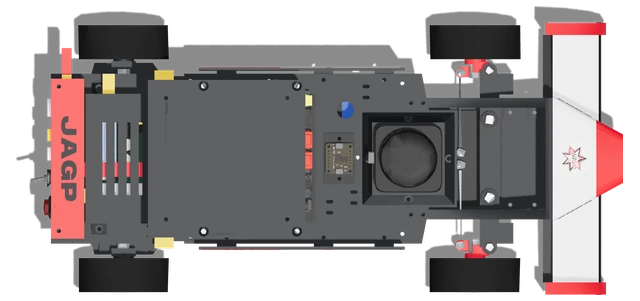
Chassis
- 1:10 scale, four wheels. Steer it however you like.
- Rolling chassis kits are allowed. The car must be built mostly by your team.
- One car per team, plus one declared spare chassis that has passed scrutineering.
COCKPIT · Tier 01
COCKPIT teams build their own 1:10-scale car and race it by radio control, with one driver on the stand. Everything a car has to meet before it reaches the grid is on this page.
Size limits
At scrutineering your car goes into a measuring frame. Check your chassis against it before you buy.
Fits: 50 mm to spare in length, 40 mm in width.
Build sheet
Your team buys its own parts and builds the car. These rules apply to every COCKPIT car, and to the spare chassis if you declare one.
Radio and control
The driver is the only thing in the control loop. Nothing on the car may think for them.
Whether gyro stabilisation built into the receiver is allowed will be set in the rulebook.
Race weekend, 4–5 April 2027
Qualifying for both tiers is on Day 1, the knockout on Day 2. The timetable is provisional until it's published.
Every COCKPIT car is inspected before it goes on the track: size, battery, kill switch, failsafe and radio. A car that passes gets a tamper-evident sticker.
Hand in your transmitter at the start of the session. It comes back when you are called to run.
One solo run per team on layout L2, from a standing start. The clock starts at the start/finish gate. Your time seeds the knockout.
Two cars per heat, grid from qualifying, start on the green light. The finishing order after penalties decides; the loser is out. A new layout each round.
The two finalists race for the win, then the awards: the podium, Monza Top Speed, the Precision Award and Engineering Excellence.
Replace the motor, the ESC, the battery type, a LiPo or the chassis, and the car has to be scrutineered again. The organisers may re-inspect any car at any time.
On the track
Your result is the time on the clock plus your penalties. Driving fast and driving clean are the same job.
Safety
Up to 64 COCKPIT cars and their batteries share one hall. These rules keep the pits safe for everyone in it.
Academy
The COCKPIT path is Courses 0 to 3. At least two members of your team complete them, with every lab checkoff signed. That's how your team becomes eligible to race.
Embedded systems, the electrical backbone and mechanical dynamics, then RC Systems Overview & Transmitter Configuration, the course for COCKPIT only.
COCKPIT questions
The car must be built mostly by your team. A rolling chassis kit is allowed as the starting point; the electrics, the setup and the rest of the build are yours.
Not in the control loop. No programmable board may run code that influences how the car is driven, and driving aids mean disqualification. Passive safety electronics such as fuses, relays and voltage alarms are fine.
Any type works, as long as it's a physical switch or pull-out link on the drive power, marked red and reachable without tools. No part or connector is prescribed.
You can declare one spare chassis. It goes through scrutineering on the same sheet as your car.
One driver per run, from the driver stand. A team has 2 to 5 members, and at most four of them can be in the pit and race area at a time.
You get 30 minutes to fix or replace it and be checked again. If it fails a second time, the car can't race.
The team fee is the same for both tiers: 60, 50 or 40 JOD depending on IEEE RAS membership. COCKPIT teams also buy their own car and parts.
Registration is open until 31 December 2026, for teams of 2 to 5.